Spotlight on Kaufman's Custom Engineered Transfer Cars
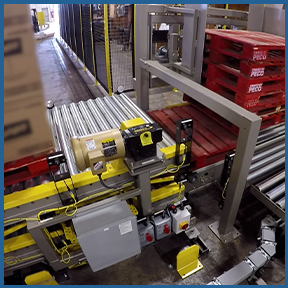
Transfer car with over-under conveyor to transport loads and pallets simultaneously.
Automated transfer cars (sometimes referred to as transfer carts or transfer trolleys) are mobile conveyor platforms that shuttle pallets, empty pallets, and dunnage across multiple parallel lanes—without building long, fixed conveyor runs. On high-speed packaging and distribution floors, they are often the simplest way to connect multiple palletizing lines to shared downstream processes such as stretch wrapping, labeling/verification, dual-load stacking, and shipping lanes. Our transfer car conveyors are specifically engineered to divert or merge palletized products, dunnage supplies, and empty pallets across multiple lanes, including transferring finished loads from several palletizer systems to a shared stretch wrapper, with designs intended for 24/7 operation.
Operationally, transfer cars help plants reduce forklift traffic and manual staging steps. That matters because forklift incidents remain a serious, persistent risk: in the U.S., nearly 100 workers are killed, and ~20,000 are seriously injured each year in forklift-related incidents, and overturns are a leading cause of fatalities.
In the sectors this page targets—food & beverage, paper & tissue, pharmaceutical & healthcare, and building products—transfer cars add value by improving throughput stability, footprint efficiency, and sequence control, while supporting sanitation, traceability, and load-stability requirements when integrated into a complete end-of-line system.
Request a Quote ---- Contact Us ---- JOIN OUR MAILING LIST ---- Videos
What Transfer Cars Are and What They Do
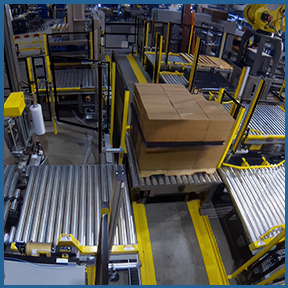
A transfer car is a track-guided mobile conveyor that moves linearly between fixed conveyor lanes to pick up and drop off unit loads. Kaufman's transfer car conveyors are floor-track systems used to deliver loads to specific workstations and to transfer loads from multiple palletizer systems to a shared location—such as a stretch wrapping station.
At a system level, transfer cars are commonly used to:
- Merge multiple palletizing lines into one downstream process (e.g., one stretch wrapper or labeling cell).
- Return empty pallets and deliver dunnage (top sheets, slip sheets, pallets, etc.) back into robot cells or palletizing stations.
- Control sequencing so the “right” load goes to the “right” station at the “right” time—especially valuable when fast and slow lines must run together.
Transfer cars provide a lower-cost layout alternative to routing product with standard conveyors, because the car itself serves as the shared transport mechanism, using less electricity and reducing maintenance requirements.
Transfer Car Architectures and Configuration Options
Guided Travel and Track Design
Kaufman transfer cars run on in-floor or above-floor track designs, using an Igus cable carrier or power rail to provide communication and power. In integrated robotic palletizing cells, Kaufman also describes configurations that use embedded floor track with an overhead electrical power rail system, particularly for higher-speed multi-position cars.
This guided, linear approach differentiates transfer cars from more route-flexible mobile automation, such as AGVs/AMRs. (If a project truly requires “trackless” navigation, the safety and validation framework typically shifts toward driverless truck standards such as International Organization for Standardization ISO 3691-4 for driverless industrial trucks—often a different solution class than a track transfer car.)
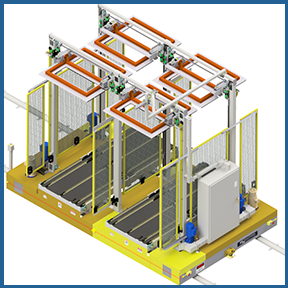
3D Configuration of a Four-Position Transfer Car
Standard "Positions" and Why They Matter
Kaufman offers multiple standard transfer car configurations—best thought of as how many loads the car can carry and how it exchanges loads between lanes:
- Single-position car: carries one load/dunnage at a time.
- Two-position, in-line car: carries a load/dunnage on two different conveyor decks and typically the two loads convey on and off simultaneously—useful when space is tight or when the car must pick up a loaded pallet and drop off an empty pallet. This layout is incredibly efficient and is generally used for higher-speed applications where load-per-hour throughput requires handling two loads simultaneously.
- Two-position, side-by-side car: carries two loads side-by-side and has the ability to drop the two loads off at the same time, so long as the centerlines of the discharge conveyors are aligned with the centerlines of the side-by-side decks. If both loads are being dropped at one station, or the centerlines of the drop conveyors are not aligned with both decks on the T-Car, one load will be dropped, followed by the second. This configuration is useful when fast lines must be supported alongside slower lines.
- Four-position car: carries two loads on “side A” and two loads on “side B,” enabling multiple drop points and dunnage returns—often selected for multiple production lines and more complex line routing. This configuration is designed specifically for applications with really high throughput requirements.
Conveying Surface on Transfer Cars
A transfer car is “a conveyor deck attached to a traveling base” in many commercial designs. That deck can be engineered to match the unit load and stability needs of the facility—commonly roller, belt, or chain conveyor decks.
It is important to note that Kaufman's transfer cars offer the option to mount high/low conveyor decks. High/low decks are commonly used so that the transfer car can simultaneously pick up a load from the top deck while dropping off dunnage from the lower deck or drop a load from the top deck while picking up dunnage from the lower deck. This option helps to increase efficiency and throughput.
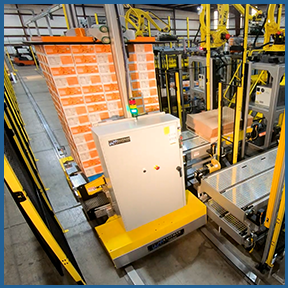
Single Position T-Car with Low-Profile Hold down
Speed, Positioning, and Load-Control Features
Kaufman offes low-speed cars up to ~120 ft/min and high-speed cars up to ~300 ft/min, with speed settings selectable across a wide range (60–300 ft/min). For high-speed designs, Kaufman notes laser positioning, load-out-of-position photoeyes, and product containment fencing.
In robotic palletizing system integration, Kaufman describes options ranging from “slow-speed single car” up to “high-speed, 300 FPM quad car laser positioned” with embedded track and overhead power rail. For unstable products, transfer cars can also be outfitted with hold-downs to preserve load stability during motion and stops.
Integration Patterns and Challenges Resolved by Transfer Cars
The Most Common Integration Pattern: Multiple Lines to One Downstream Station
At Kaufman Engineered Systems, we explicitly frame transfer cars as the mechanism that ties multiple robotic palletizing lines to a common stretch wrapper, picking up full loads and/or delivering dunnage into the robot cell.
A representative Kaufman system for multiple production lines uses one transfer car to offload completed unit loads to a main material handling line, send those loads through a labeling/verification cell in sequence, and return empty pallets back to individual palletizing cells for replenishment.
This pattern directly addresses typical end-of-line constraints: limited floor space for duplicate equipment, uneven upstream cycle times between lines, and the need to stage loads for stable wrapping and shipping.
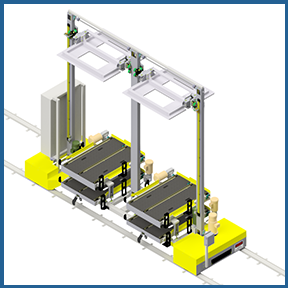
3D Configuration for a Two-Position Transfer Car
Line Balancing, Staging, and Sequencing Control
Transfer cars are frequently chosen when a plant needs “routing intelligence” without complex conveyor networks. Kaufman’s two-position side-by-side and four-position options are explicitly positioned for mixed line rates, multiple production lines, and multiple drop-off points (including dunnage returns).
Sequencing also supports traceability and correct downstream handling. In Kaufman’s multi-line case study, pallets run through a labeling cell in sequence so that like product can be double-stacked appropriately at the end of the line. That kind of deterministic routing becomes more important as customers demand clearer “license plate” identification of pallets and logistic units, often using standardized identifiers such as the GS1 US SSCC, an 18-digit identifier used to identify and track logistic units like pallets.
Dock Staging and Warehouse Interfaces
While many transfer cars operate within packaging cells, some manufacturers position them as high-speed connectors between production areas and warehouse flow systems, capable of rapid loading/unloading of full and empty pallets. For facilities that want controlled staging lanes near docks (without forklift congestion), a track-guided transfer vehicle can add structured routing and predictable handoffs to shipping lanes.
Transfer Cars In Action
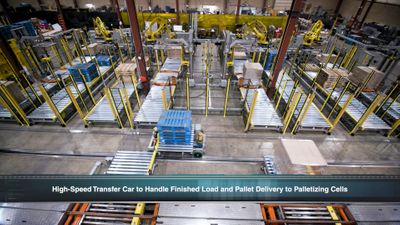
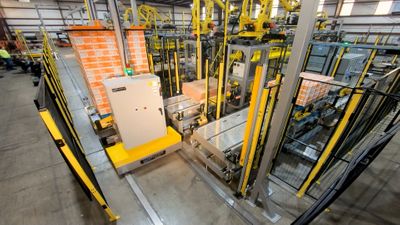
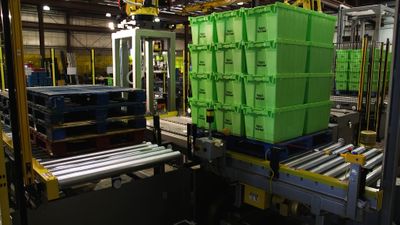
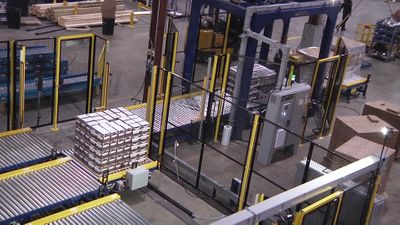
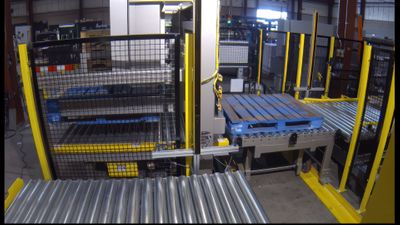
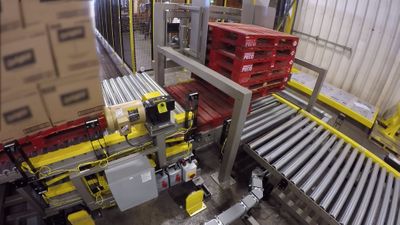
Make Multi-Line Pallet Routing Simpler, Safer, and Faster
Kaufman transfer car conveyors deliver precise, lane-to-lane pallet movement—so you can feed shared wrapping, labeling, stacking, or shipping stations without building long conveyor runs or depending on forklifts for every transfer.
- Throughput stability: configurable speeds (up to 300 FPM), laser positioning, and multi-position cars to keep mixed-rate lines synchronized.
- Footprint wins: centralize downstream equipment and return empty pallets or dunnage efficiently—reducing duplication across lines.
- Safety + forklift reduction: reduce powered industrial truck (PIT) traffic in congested end-of-line areas (where severe incidents still occur) and apply guarding + risk-based safety practices aligned with Occupational Safety and Health Administration and International Organization for Standardization norms.
- Sequencing & compliance readiness: route loads in order through labeling/verification, and engineer for cleanability where U.S. Food and Drug Administration food regulations require it.
From retrofit upgrades to greenfield automation, Kaufman custom-engineers the complete solution—transfer car mechanics, Allen-Bradley controls with safety PLC options, KEYENCE safety scanners, and seamless handoffs to dual-load stackers (pallet-insertion side-entry and in-line) and stretch wrapping.
Next step: schedule a site survey and throughput study, request an ROI/OEE model, and validate performance with a pilot plan and Factory Acceptance Testing (FAT).
Request a Quote ---- Contact Us ---- JOIN OUR MAILING LIST